
How to Search Criminal Dockets
Felony searches begin with the Morris County District Clerk, whose official page links limited online Case Summaries. County-level misdemeanors instead belong on the County Clerk route. Fine-only Class C cases may remain with the Justice of the Peace or the city municipal court that issued the citation. A federal prosecution belongs in the Eastern District of Texas, Marshall Division, not the Morris County portal.
Have the name as filed, an approximate year, and the court or cause number if known. The public Tyler interface could not be inspected reliably during research, so no specific field or local case-number pattern is promised. Treat a match as a lead. The clerk's file is the source for an official judgment or certified copy.
- Classify the charge by court level before opening a search channel.
- Follow the appropriate clerk's link to Tyler Public Access when that portal is available.
- Compare the name, court, and cause number before relying on a result.
- Read each event in sequence, especially the latest setting and disposition.
- Call the record-holding clerk for missing older cases or an official copy.
Morris Felony Dockets Use Suite J
The District Clerk keeps Morris County felony, family, and district-court records at the county courthouse, 500 Broadnax Street, Suite J, Daingerfield. The office phone is 903-645-2321. Its online notice says Case Summaries are limited and older cases may not appear. That warning changes how a failed search should be read: no online result does not prove that no file exists.
The official District Clerk screen shows the local scope and access notice.
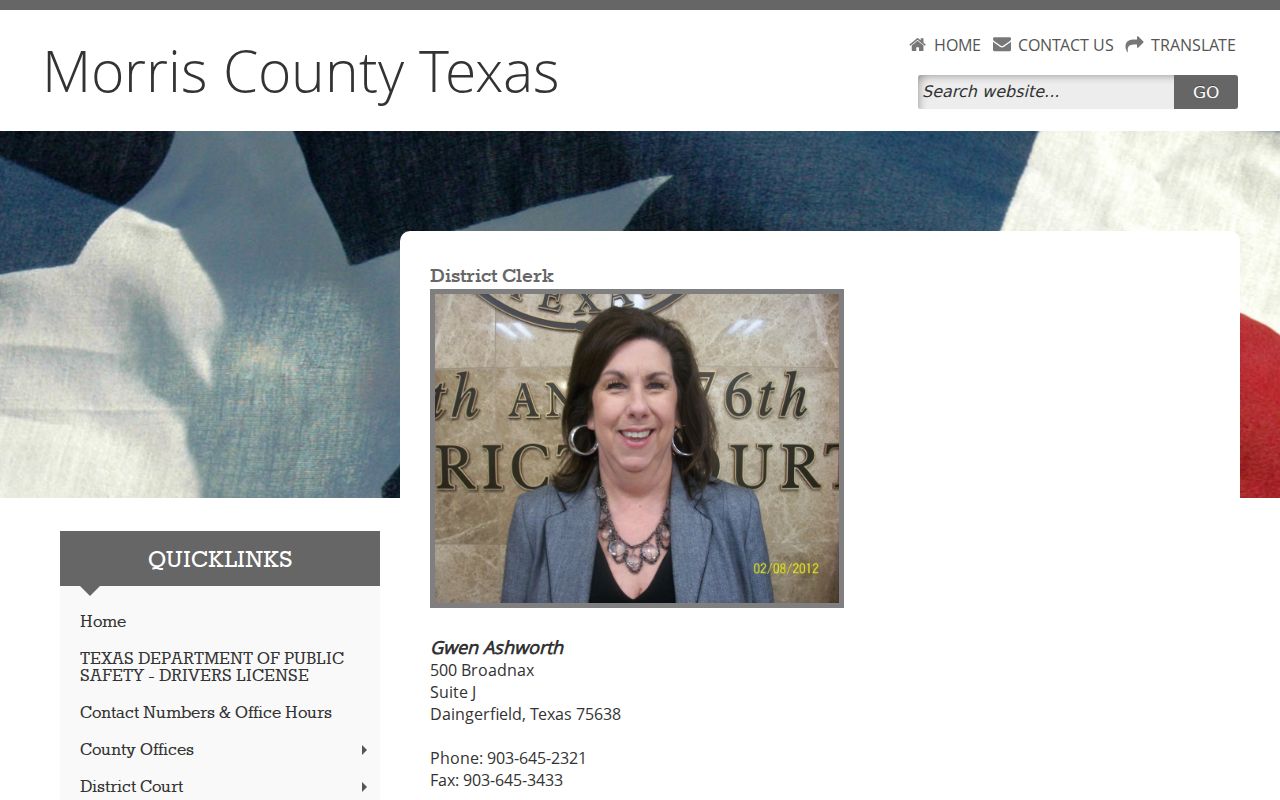
The image supports the felony routing and limited-summary caution; it is not a sample defendant record.
What a Criminal Docket Shows
A criminal register may record the charging instrument, court, filing date, counsel roles, bond events, pleas, motions, hearing settings, orders, sentencing, disposition, and appeal events. These are event types supported by the research, not a verified inventory of Morris Tyler labels. An entry is a brief index line. Read the filed instrument when the exact language matters.
| Cause number | The court's identifier; quote the exact value shown rather than assuming a format such as CR-#####. |
|---|---|
| Charge | The alleged offense or charging event, which is not itself a conviction. |
| Setting | An arraignment, pretrial event, hearing, trial, or sentencing date. |
| Plea | The plea event as entered, distinct from the final judgment. |
| Disposition | The recorded outcome and date, subject to later appeal or other action. |
Morris Criminal Docket Terms
Short register entries can look conclusive when they are not. Read several events together and ask for the underlying order when the outcome matters.
- Bond
- A release condition or security entry, not a finding of guilt.
- Setting
- A scheduled court event; it may be reset.
- Disposition
- The recorded result of a charge or case.
- Judgment
- The signed court document stating the adjudication and sentence.
A pending charge is not a conviction. A dismissal, deferred result, appeal, or later signed order may alter what an earlier line seems to mean.
Stages on a Criminal Docket
A felony register may begin with a charging or indictment event, followed by arraignment, bond activity, motions, pretrial settings, and a plea or trial. Sentencing and judgment entries follow a conviction. Dismissal may end a charge without that route. Continuances and notices explain why the sequence contains more than one setting.
Docket flow: Charge Filed › Arraignment › Pretrial Settings › Plea or Trial › Disposition
Morris Criminal Docket Counts
The Texas OCA CARD system reported 99 active criminal cases pending at the start of 2023, 68 reactivated, 137 added, 87 disposed, 68 moved inactive, and 147 active pending at year end. Those totals describe aggregate district-court activity. They do not identify a person or predict how long one case will take.
The reactivation and inactive columns also show why a simple open-or-closed label can miss part of the docket history.
Which Court Holds Criminal Dockets
The 76th and 276th Judicial District Courts handle felonies through the District Clerk. Morris County Clerk records include county-level criminal misdemeanors. The Morris Justice of the Peace and five municipal courts keep fine-only matters within their own channels. Federal criminal cases use the Marshall Division's PACER and CM/ECF systems.
This division means a Morris address alone is not enough. Use the court named on the charging paper or citation. A district felony will not become a municipal record, and a city ticket may never appear in the county Tyler summary.
The county's 76th District Court page identifies one of the two district routes serving Morris felony matters.
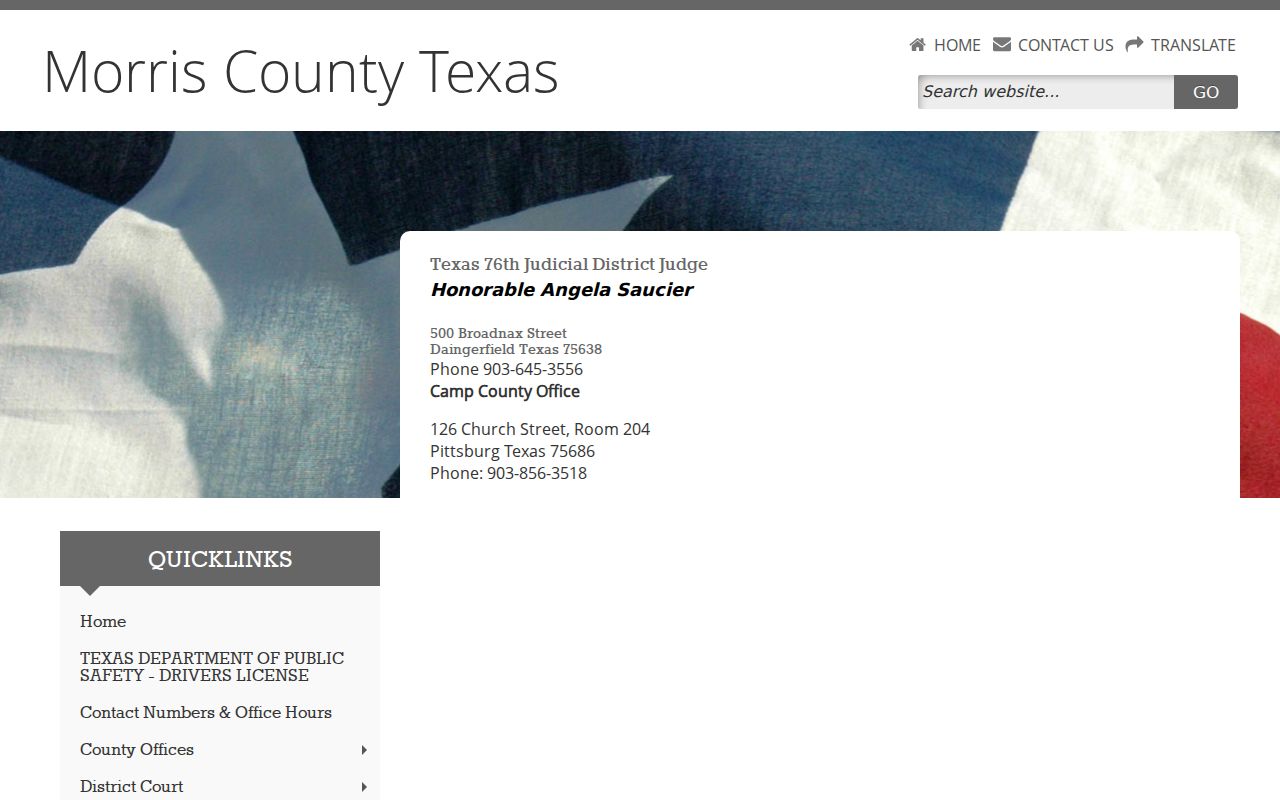
The court screen helps identify the tribunal; the District Clerk remains the keeper of the criminal docket and filed record.
The prosecutor's office and Community Supervision and Corrections Department can explain their own roles, but neither replaces the clerk's docket. Morris CSCD serves district and county courts at 500 Broadnax and publishes 903-645-3166. No separate public probation docket search was found. For the official event history, return to the correct clerk.
Confirm Morris Criminal Docket Settings
A Case Summary and a calendar answer different questions. The summary traces a case, while the District Court Calendar page publishes district scheduling documents. For a setting, compare both and then call the coordinator or clerk. Morris also tells jurors to call the District Clerk at 903-645-2321 after 5 p.m. on the day before trial because instructions may change.
Bring file-marked paperwork when relevant. Under the 2025 local procedures, hearing notices and requests are e-filed rather than sent by ordinary email or fax. A calendar appearance does not prove a motion was filed.
Offline Morris Criminal Dockets
An older felony can exist even when the online Case Summary does not. Start by checking that the search was made in the district-court channel and that the spelling, year, and court are plausible. Then call Suite J with the cause number or the best available identifying facts. Ask for an index or docket search and state whether the need is for a docket sheet, a signed judgment, or a certified copy. District Clerk procedures list emailed copies at $0.10 per page, but the current certification charge was not reliably extracted from the scanned schedule and should be confirmed before ordering.
For county misdemeanors, use Suite D and 903-645-3911 instead. The County Clerk requires public-information requests to be in writing, yet a judicial case-file request and an administrative public-information request are not always handled under the same rule. Describe the actual record and let the custodian identify the proper route.
Case summary or judgment? The summary shows indexed events. The signed judgment states the court's official ruling, and a certified copy is the clerk-authenticated version.
Public Access and Sealed Criminal Dockets
Texas court records commonly begin from a presumption of access, but criminal access has real limits. Juvenile material, sealed or expunged records, protected identifiers, and records restricted by court order may be absent or redacted. “Restricted,” “redacted,” “sealed,” and “expunged” are not synonyms. The clerk can identify the public access procedure but cannot release material a law or order protects.
Key Rules:
Texas Rule of Civil Procedure 21c requires sensitive-data redaction in filed documents.
Texas Family Code Chapter 58 restricts access to juvenile justice information.
Texas Rule of Judicial Administration 12 addresses judicial records but excludes records maintained in a case file.
For a missing entry, ask whether the cause is older than portal coverage, in another court, or subject to an access restriction. Request the docket sheet, judgment, or certified record by name rather than asking for “everything.”
The District Clerk's Suite J route and the County Clerk's Suite D route also differ by offense level. A felony file belongs with the district courts, while the County Clerk lists county misdemeanors among its records. Fine-only Class C matters can remain with a municipal court or Morris JP. Give the clerk the court name, approximate year, and cause number if known. This avoids treating a search in the wrong criminal index as proof that no record exists.
For an official outcome, distinguish the docket event from the filed judgment. The event line may state that a judgment or dismissal was entered, but the signed document contains the operative terms. Ask whether a public redacted copy is available and whether certification is required. The District Clerk publishes a $0.10-per-page charge for emailed copies under its 2025 procedures; current certification costs and accepted payment methods should be confirmed directly before placing an order.